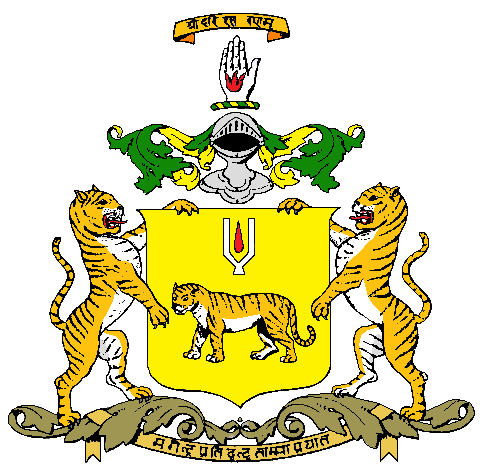

Overview
Browse our visual repository!
Rewa - Visual RepositoryRewa
- Last King: Maharaja Martand Singh
- Size: ~33, 000 km²
- Population: ~18 lakhs (1941 Census)
- Accession to India: 16 August 1947
- Post-Independence Union: Vindhya Pradesh
Background
Maharaja Gulab Singh ascended the throne of Rewa in 1922, presiding over an era of intrigue and tensions which resulted in one of the most interesting attempts to institute a state Constitution.
The early administration of Maharaja Gulab Singh was marked by oppressive revenue demands, and tensions between the raja, landlords and the Congress. Even when pushed by the British to institute administrative reforms, Gulab Singh resisted it stating that he ‘ran his state quite well on traditional lines’
The 1940’s saw a tussle with the British, with a brief deposition of Gulab Singh from the throne.
A move towards Constitutional reform
On 19th October 1945 in his Dussehra Darbar, Maharaja Gulab Singh made a very important announcement: That Rewa would have a fully responsible government, separate electorate and universal franchise.
This statement stirred the ire of the British – seen as a direct challenge to their authority and they eventually deposed him, in favour of his son.
However, the process of constitutional reform in Rewa continued. Sir Hari Singh Gour was appointed as the Chairman of the Rewa Reforms Committee – hired at a sum of INR 25,000. The Committee was to ‘enquire and recommend a form of Constitution for the state which will ensure the formation of a popular government’
Simultaneously, a Rewa Praja Mandal (people’s committee) was formed. This body proposed popular elections and elected representatives as the way forward, and a rejection of the Crown appointed Gour Committee.
On May 27, 1947, the Reforms Committee submitted its reports to the Raja. The committee recommended a representative government, including sections on fundamental rights, law and justice and the executive. One of the members of the committee dissented stating that the people were not ready for responsible government and a monarchical system must continue, and included a request for minority representation across all administrative arms of the government.
Merger with the Indian Union
Before these reforms could be set in motion, Rewa acceded to the Indian nation. On 24 April, 1947 the States Committee officially acknowledged that Rewa was to join the Constituent Assembly and had nominated members. Rewa went on to become among the first princely states to represent Central India in the Constituent Assembly.