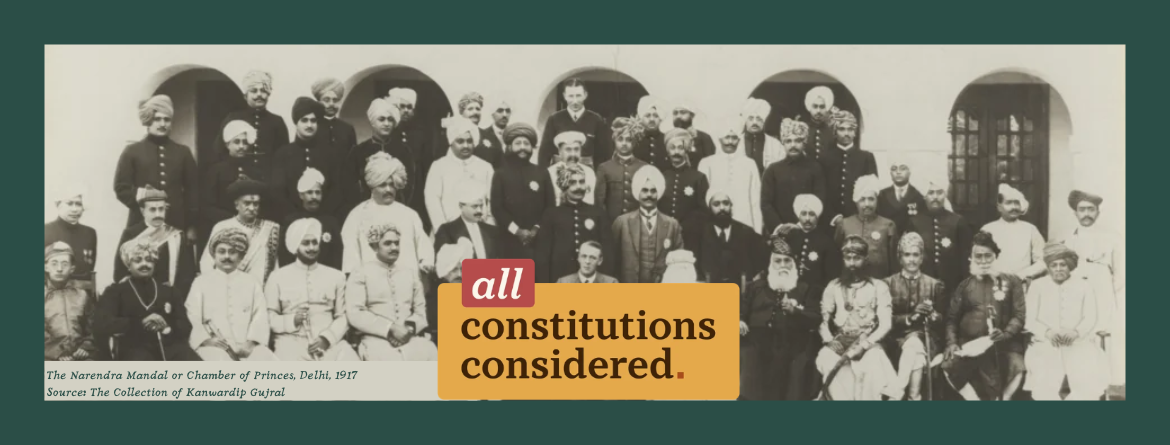
A key principle that underpins all our work is making research and constitutional histories accessible. That is what this database does.
It maps the fragmented landscape of parallel constitutional activity across the princely states. It allows researchers, students, and historians to investigate whether, how, and by whom democratic instruments such as written charters, representative assemblies, and civil liberties were attempted or enacted outside direct British governance.
How is the data organized?
Every state record, document, and timeline entry on this platform is indexed along three complementary analytical axes.
- Locus of Initiative : This helps unpack who initiated the constitutional process.
- Stage of reform: How far did that process progress ?
- Sources: What archival evidence documents this process?
Locus of Initiative
What it asks: Where did the constitutional impulse originate?
This field identifies the primary political agent or structural catalyst that initiated or directed the constitutional process in question.
- Ruler-Led: Reforms, proclamations, or draft constitutions conceived and enacted from the top down by the Prince, their Dewan, or the Durbar. These initiatives were often framed as modernizing administrative acts, benevolence, or preemptive reforms intended to forestall popular agitation while preserving the monarchical core.
- Praja Mandal: Constitutional agitation, draft charters, and demands for fundamental rights driven from the bottom up by grassroots political organizations (States’ Peoples’ Conferences/Praja Mandals). These movements represented the subjects of the states demanding responsible government, civil liberties, and an elected legislature.
- Colonial Pressure: Constitutional adjustments or institutional reorganizations driven or mandated by the British Paramount Power via the Political Department, Resident, or Viceroy. These pressures usually aimed to address gross administrative incompetence, modernize tax and legal structures to safeguard imperial interests, or compel princes to cooperate with wider all-India federal schemes (such as the Government of India Act 1935).
Stage of reform
What it asks: What was the outcome of the demand or reform?
This tracks the evolutionary stage of the constitutional activity within a princely state, documenting whether democratic and constitutional aspirations remained dormant, were actively crushed, or culminated in enduring legal frameworks.
- No Demand: Characterizes states or periods where there was no visible, organized public mobilization, petitioning, or elite proposal demanding responsible government, or representative assemblies. Autocracy functioned without noticeable organized civil friction.
- Suppressed: Constitutional demands or civil liberties campaigns existed but were actively dismantled by the state. This includes bans on political organizing (such as Praja Mandals), preventative detention of leaders, censorship of political systems, police crackdowns, or the deliberate dissolution of reform initiatives before they could gain legal standing.
- Attempted: Formal or informal efforts were initiated to draft, propose, or negotiate constitutional reforms, but they failed to materialize into functioning governing frameworks. This encompasses reform committees whose recommendations were shelved, draft charters rejected by the durbar or political department, and abortive political agreements.
- Institutionalised: Constitutional mechanisms were enacted. This includes establishing functioning representative assemblies (Legislative Assemblies, Praja Sabhas or Dharasabhas), representative elections, local self-government bodies, etc. These could also include a veto power with the monarch.
- Notified: This includes a formal constitutional reforms process and notification of constitutional mechanisms. At this stage, constitutional or legal reforms, though not fully enacted, were formally notified, officially announced, or gazetted by the authority. However, due to accession with the Indian Union these reforms were not formally enacted or institutionalised.
- Formalised: The highest threshold of constitutional evolution, where the state codified and promulgated an official, legally binding written constitution, fundamental rights charter, or instrument of responsible government. It represents the explicit transition from discretionary sovereign authority to codified constitutional law.
Sources
What it asks: Whose voice and perspective are we reading?
This section outlines the types of primary and secondary evidence featured on the database.
- Abhilekh Patal: The digital access portal of the National Archives of India (NAI), primarily containing records of the Foreign and Political Department, Crown Representative Records, Residency correspondence, intelligence summaries, and confidential fortnightly reports on political developments in the states. This is the most exhaustive archival material we have access to including original constitutional documents, instruments of accessions, and correspondence.
- Academic Sources (Books, Research Papers): Peer-reviewed historical scholarship, secondary analyses, and academic journal articles that contextualize political mobilizations, interpret regional durbar politics, and trace institutional development across the states.
- Constituent Assembly Debates: Official verbatim records of the proceedings of the Constituent Assembly of India (1946–1950), detailing debates over the accession, federal representation, negotiating committee discussions, and constitutional integration of the princely states into the Indian Union.
- Digital District Repository (Azadi Ka Amrit Mahotsav): Micro-historical records, district-level administrative histories, local oral traditions, and regional government documentation highlighting grassroots resistance, local satyagrahas, and lesser-known constitutional struggles at the sub-state or taluk level.
- Nehru Archives (NMML / Prime Ministers Museum & Library): Archival holdings originating from the private papers collections at the Nehru Memorial Museum and Library, primarily the papers of the All-India States’ Peoples’ Conference (AISPC), correspondence of national leaders (such as Jawaharlal Nehru and Vallabhbhai Patel), and regional Praja Mandal bulletins submitted to national congress leadership.
- Visual Repository: Images relating to the princely states, including coats of arms, portraits of rulers, newspaper announcements, and other contemporary printed material. These sources offer insights into how princely authority was represented, political developments were communicated, and public life was documented.