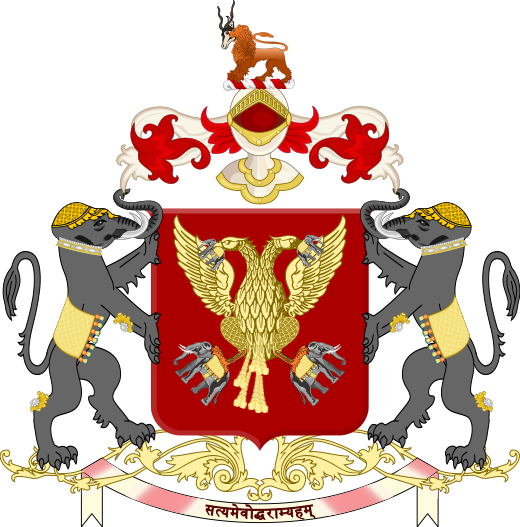

Visit the Visual Repository!
Mysore- Visual RepositoryMysore
- Last King: Maharaja Jayachamarajendra Wadiyar
- Size: ~75,000 km²
- Population: ~73,29,140 (1941 Census)
- Accession to India: 9 August 1947
- Post-Independence Status: Continued as a separate Part B State of the Indian Union from 26 January 1950, with the Maharaja serving as Rajpramukh. It was reorganised into the enlarged Mysore State on 1 November 1956, which was renamed Karnataka in 1973.
Background
Mysore was one of the best governed princely states in the sub-continent. It housed Asia’s first hydroelectric power station at Shivanasamudra, gold mines at Kolar and the first city in India with electric street lighting (Bangalore in 1905).The achievements of the state are too long to list but it was a beacon of science, industry and administration. Mysore was one of the earliest princely states to introduce representative governments. As early as 1881, Maharaja Chamarajendra Wadiyar X established the Representative Assembly. Its powers, however, were limited and the executive authority remained firmly with the Maharaja.
Demand for a representative government
By the late 1930s, demands for responsible government had gained momentum, partly under the influence of the independence movement. In response, the Mysore administration appointed a Constitutional Reform Committee under K. R. Srinivasa Iyengar in 1938. Its report, submitted on 31 August 1939, recommended reforms that culminated in the Government of Mysore Act, 1940, promulgated on 30 April 1940.
The Government of Mysore Act, 1940
The Act, comprising 47 sections across seven chapters, established a Council of Ministers, a Representative Assembly of ordinarily 310 members and a Legislative Council of 68 members. The Legislative Council could enact laws and vote on demands for grants, while the Representative Assembly could discuss the principles of proposed legislation and the general budget.
Despite introducing a more elaborate representative framework, the Act did not establish responsible government. Executive authority remained with the Maharaja and the legislature's powers were subject to significant restrictions. The gap between constitutional representation and actual political power remained a major source of dissatisfaction. Political demands increasingly extended beyond institutional reform to include civil liberties and a government accountable to the people.
This demand led to the Mysore Chalo agitation in September 1947, in which the Mysore State Congress and other political leaders mobilised public support for responsible government. As the movement grew in popularity, the continuation of the monarchical structure became implausible
Merger and a Constituent Assembly of Mysore
On 29 October 1947, the Maharaja issued a proclamation announcing further reforms, including an expanded Ministry responsible to the Legislature and the establishment of a Constituent Assembly of Mysore composed of elected representatives. The Assembly was entrusted with the task of preparing a constitution for Mysore that would provide for responsible government.
As the national constitutional framework took shape, the Mysore Assembly decided that the Constitution of India should also govern the state, instead of proceeding with a separate constitution. Acting on this recommendation, the Maharaja issued a proclamation on 25 November 1949 adopting the Constitution of India for Mysore. The proclamation ordered the dissolution of the Representative Assembly and Legislative Council with effect from 15 December 1949 and provided for the Mysore Constituent Assembly to function as the Legislative Assembly until a new legislature could be constituted under the Indian Constitution. When the Constitution came into force on 26 January 1950, Mysore became a Part B State of the Indian Union.